Monday, May 2, 2011

Where Is The Female G Spot Located?


-This video shows the easiest way to find the Female G-Spot-


Have you ever discovered it by yourself?


The Gräfenberg Spot, often called the G-Spot, is the bean-shaped area of the vagina. Many women report that it is an erogenous zone that, when stimulated, can lead to strong sexual arousal, powerful orgasms and female ejaculation. The Gräfenberg Spot is typically located one to three inches (2.5 to 7.6 cm) up the front (anterior) vaginal wall between the vaginal opening and the urethra and is a sensitive area that is part of the female prostate.


Although the G-Spot has been studied since the 1940s, disagreement persists over its existence as a distinct structure, definition and location.A 2009 British study concluded that its existence is unproven and subjective, based on questionnaires and personal experience.There is also hypotheses that the G-Spot is an extension of the clitoris and that this is the cause of vaginal orgasms.Other studies, using ultrasound, have found physiological evidence of the G-Spot in women who report having orgasms during intercourse.


Sexual psychologists are concerned that women may consider themselves to be dysfunctional if they cannot find their G-Spot. Women have undergone a plastic surgery procedure called G-Spot amplification to enhance its sensitivity.


Sexual stimulation and studies


The G-Spot is typically located about 50 to 80 mm (2 to 3 in) inside the vagina, on the front wall. For some women, stimulating the G-Spot creates a more intense orgasm than clitoral stimulation. The G-Spot needs direct stimulation, especially with firm moves and constant pressure as it is ~1 cm below the surface. Stimulating the G-Spot through sexual penetration, especially in the missionary position, is difficult to achieve because of the special angle at which penetration must occur. It is claimed that the best G-Spot stimulation is achieved by using both manual stimulation and sexual intercourse.


Spoons Position


It is said that the best sexual position to reach G-spot is the spoons position or spooning is a sexual position and a cuddling technique. The name derives from the way that two spoons may be positioned side by side, with bowls aligned. In the sexual spoons position, the penetrative partner lies on one side, with knees bent. The receptive partner also lies on the same side, with back pressed against the penetrative partner's front. Both partners' upper bodies may be pressed together or separated with just the pelvises connecting, and their legs can also rest on top of each other. The receptive partner may have to lift the upper knee to allow for easier penetration. This has been called one of the "Basic Four" sex positions.


This rear-entry position allows for a great deal of physical intimacy, as there is full-body contact which allows for cuddling. The man (outer spoon) can caress the woman's stomach and breasts, as well as the back of the neck and ears, while stimulating the clitoris if desired. The woman can also stimulate her own clitoris or her partner's scrotum. In addition, the penis stimulates the front of the vagina or the G-Spot. Along with the doggy style position, this is probably the best position from which to reach the G-Spot. Both partners have control of the angle and depth of penetration, and slow, low-intensity sex can last for a long time because it usually takes longer for the man to reach orgasm. Anal sex is also possible in this position, along with use of a vibrator. However, there is little visual stimulation for either partner, as they are not facing one another and cannot see each other's bodies fully. The penis can also slip out easily. Variations on this position include the partners lying on their sides face-to-face or in the "scissors" position.


The spoons position may be preferable for couples who have just woken up or are very tired. It may be used if the woman is pregnant, even during the last trimester, because it does not put any pressure on the abdomen. It is also good for those recovering from illness or surgery, or the elderly, because it puts less strain on muscles.


Most Roman erotic art depicted couples in the spoons position.


Reference:


  1. http://en.wikipedia.org/wiki/G-Spot

  2. http://en.wikipedia.org/wiki/Spoons_sex_position

Testosteron Treatment Options: Choices and Non Choices in The World. By: Prof Ronald S. Swerdloff, MD (UCLA)

Berikut adalah hasil dari Pertemuan Ilmiah Tahunan Persandi V-Pandi XIX, dengan judul Current Hopes in Sexual Dysfunction and Infertility Solution, yang bertempat di Grand Sahid Jaya Hotel Jakarta, 27-29 April 2011


Testosteron Treatment Options: Choices and Non Choices in The World. By: Prof Ronald S. Swerdloff, MD (UCLA)


Testosterone is the principal male hormone produced in the testes. It is an anabolic steroid that acts directly as a hormone on the nuclear androgen receptor or on the cell surface rapid acting signaling pathways; it also can create its biological effects acting as a pre-hormone substrate for its metabolites such as estradiol and dehydrotestosterone (DHT). Testosterone acts on many target organs with different level of tissue responsiveness and different characteristics of the dose response curve.


Testosterone medications are usually reserved in men as a treatment for hypogonadism (low testosterone).


There are many treatment formulations and delivery routes available.


Routes of administration include:


1. Oral--> medications include testosterone esters such as testosterone undecanoate (TU) or 17 alkylated testosterone such as methyl testosterone. The oral TU available in many countries is short acting, requires administration with food, two or three times a day;


One example of this kind of medication is: Andriol®


2. Trans-buccal --> is given twice daily and gives reasonably constant levels at equilibrium;


This picture shows how to apply the transbuccal testosterone


One example of this kind of medication is: Striant®


3. Trans-dermal --> trans dermal testosterone are very popular and can be given as gels, patches and roll ons. They are usually once a day preparations with acceptable pharmacokinetics. The gels are relatively free of the skin irritation seen with closed system patches. The disadvantage of gelsis the possibility of transfer by skin to skin partners or children.


Examples of this kind of medication is: Androderm ®, Androgel®,  Tostrex®,


4. Injectable --> Injectables can be intermediate lasting such as testosterone enanthate and sypionate giving peak values at days 1-2 after injection and nadirs at about 10 days. There are peaks and valleys when given as a q2week (once every teo week) regimen so some clinicians favor smaller dose weekly injections.


Testosterone Enanthate


Longer acting testosterone injectables are available in many countries (but not the USA) with injections required only once every three months. Injectables have the disadvantage of requiring somewhat uncomfortable delivery.


Nebido® is one example of long acting testosterone injectable (Testosterone Undecanoate)


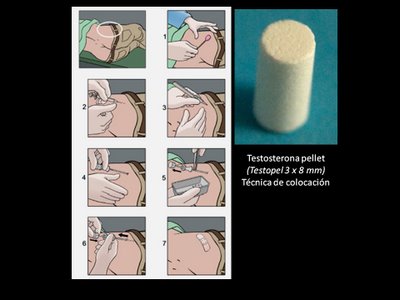
5. Subcutaneous pellets --> Long term pellets are even longer lasting but may require some skill in administering and may extrude from side.


Testopel® is one example of testosterone pellet


Warning: before you decide to give yourself a Testosterone Replacement Therapy (TST), you should first contact your physician.


Do not use any testosterone if you:


  • have breast cancer (rare in men).

  • have prostate cancer.

  • are a woman (especially if you are pregnant or breast-feeding). TST  may harm the babies of pregnant and breast-feeding women.

  • are allergic to testosterone.


Tell your doctor if you have or had:


  • problems urinating due to an enlarged prostate.

  • liver problems.

  • kidney problems.

  • heart problems.

  • lung problems.

  • diabetes.


Tell your doctor about all the medicines you take, including prescription and non- prescription medicines, vitamins, and herbal supplements.
PS: You may copy this post as long as you give link to this page, thanks.
-All picture is copyright to their respective owners-
-I'm not affiliated with nor endorsed by any product mentioned above-

(click the picture to enlarge)
From left to right
1. Prof. Dr. Nukman Moeloek, dr, SpAnd (Indonesia Senior Andrology Specialist)

2. dr Yuan Ade Sukma (myself)

3. Prof. Christina Wang, dr, PhD (President of ISA WHO, 2011)

4. Prof. Ronald S. Swerdloff, MD (UCLA)

5. Prof. Dr. KM Arsyad, DABK, SpAnd ( Chief of PERSANDI, 2011)

Saturday, April 30, 2011

Hormonal Male Contraception, by: Prof . Dr. Nukman Moeloek, dr, SpAnd

Berikut adalah hasil dari Pertemuan Ilmiah Tahunan Persandi V-Pandi XIX, dengan judul Current Hopes in Sexual Dysfunction and Infertility Solution, yang bertempat di Grand Sahid Jaya Hotel Jakarta, 27-29 April 2011


Kontrasepsi Hormonal Pada Pria


Abstrak


Penelitian Kontrasepsi pria akhir-akhir ini di arahkan pada penggunaan hormon dengan kombinasi antara androgen dan progestogen. Dari hasil beberapa penelitian terakhir, hasilnya cukup menjanjikan, meskipun masih terus disempurnakan untuk dapat diaplikasikan pada masyarakat luas. Androgen yang diberikan berfungsi untuk menekan hormon gonadotropin, sehingga dapat menekan spermatogenesis dan juga untuk mempertahankan kadar testosteron darah sehingga tidak menimbulkan efek yang tidak diinginkan seperti halnya penurunan libido pada pria. Sedangkan progestogen diharapkan dapat lebih menekan hormon gonadotropin sehingga semakin menekan spermatogenesis. Seperti yang dinyatakan oleh Lam et al, (2005), bahwa regimen kombinasi androgen+progestogen adalah pendekatan sangat menjanjikan untuk pengembangan regimen kontrasepsi hormonal pria.


Segala upaya riset yang dilakukan tentunya berujung pada diterapkannya kontrasepsi hormonal pada pria yang bertujuan untuk mengatur jumlah penduduk Indonesia atas peran aktif pria dengan harapan dapat meningkatkan kualitas hidup manusia indonesia. Serta mengurangi beban wanita yang selama ini lebih banyak "menderita" akibat KB.


Penelitian kombinasi androgen dan progestogen jangka panjang yang dilakukan oleh Moeloek dkk, 2002, menggunakan Testosteron Undekanoat (TU) dan Depot Medroksi Progesteron Asetat (DMPA), pada 40 pria Indonesia, di Jakarta dan Palembang, menunjukkan semua pria mencapai azoospermia.


Moeloek dkk, saat ini telah berhasil melakukan penelitian membuat TU dan DMPA menjadi satu emulsi yaitu mikroemulsi TU/MPA sehingga lebih mudah diterima masyarakat karena untuk aplikasinya akseptor hanya perlu satu kali disuntik setiap datang.


Selain itu, WHO/CONRAD sedang melakukan penelitian multisenter kombinasi androgen dan progestogen jangka panjang, TU dan Noretisteron Enantat (NET-EN) dengan penyuntikan tiap 2 bulan sekali untuk melihat keampuhannya (ketidak hamilan pada pasangan sang pria) di beberapa negara. Di Indonesia, penelitian ini sedang dilakukan oleh Moeloek dkk, pada 65 partisipan dengan hasil yang sangat menjanjikan. Sampai saat ini tidak ada istri pasangan pria yang hami;, dan telah memasuki fase reversibilitas serta diharapkan akan selesai 3 bulan mendatang.


Tentang Peneliti:


Prof . Dr. Nukman Moeloek, dr, SpAnd adalah seorang dr Spesialis Androlog yang telah berpartisipasi dalam banyak penelitian nasional dan internasional. Tentang kurikulum beliau yang lebih lengkap silakan lihat di sini.


-Berbagi Ilmu, Untuk Kehidupan yang Lebih Baik-


(klik gambar untuk memperbesar)

Dari kiri ke kanan


1. Prof. Dr. Nukman Moeloek, dr, SpAnd


2. dr Yuan Ade Sukma (saya pribadi)


3. Prof. Christina Wang, dr, PhD (President of ISA WHO, 2011)


4. Prof. Ronald S. Swerdloff, MD (UCLA)


5. Prof. Dr. KM Arsyad, DABK, SpAnd ( ketua PERSANDI, 2011)


PS: kalau mau kopi paste monggo, terimakasih anda telah turut berbagi ilmu, tapi mohon sertakan link kesini ya, hargailah saya yang telah bersusah mengetik ini, apalagi koneksi internet di rumah byar pet, nunggu loadingnya lama sekali sampai lupa mandi hehehe. O iya jangan lupa ditunggu komennya, mari bangun Indonesia menjadi lebih baik.


Malang, 30 April 2011 jam 20.00